

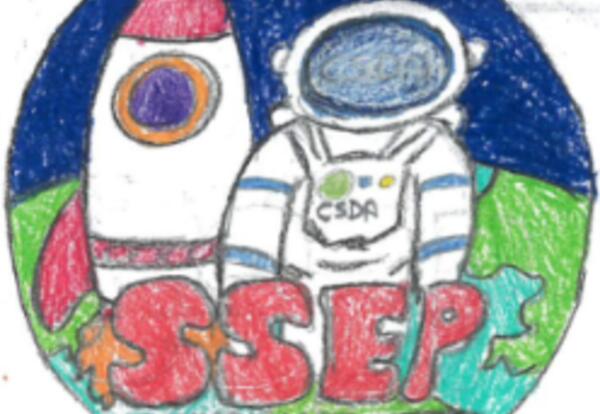
What began as a science class assignment turned into a mission for Nathaleej Labaro!
The North Albany Middle School student won the Student Spaceflight Experiments Program (SSEP) Mission Patch Design Competition for the 糖心传媒 and, as a result, the seventh-grader's design is headed to the International Space Station later this spring.
District students in grades 6-8 are introduced to the patch competition and are challenged to complete a submission. The district's SSEP Review Panel received more than 200 patches before naming Labaro's the winner. A paper copy of the patch will accompany the mini-lab experiment, investigated by a team of student-scientists from William S. Hackett Middle School, on Mission 21.
SSEP is a competition involving high school and college students from the United States and Canada and is part of our middle school science curriculum.
According to a description on the SSEP website, the goal is to immerse and engage "students and their teachers in every facet of real science - on the high frontier - so that students are given the chance to be
scientists and experience science firsthand." 
Congratulations to Labaro on this exciting exploration, journey and learning experience!
Congratulations, also, to guiding teacher Julie Gall who is featured in the photo at right to the right of Labaro along with the 糖心传媒's Secondary Instructional Supervisor for Science Amanda Powers (left) and North Albany Assistant Principal Kewsii Burgess (right).
The district's participation in Mission 21 is now complete but information about North Albany, Hackett and Stephen and Harriet Myers Middle School students will participate again next year, beginning in the fall.
糖心传媒 SSEP
The Student Spaceflight Experiments Program is a program of the National Center for Earth and Space Science Education in the U.S. and the Arthur C. Clarke Institute for Space Education internationally. It is enabled through a strategic collaboration with Rhodium Scientific, America’s first space biotech and ISS Commercial Service Provider, working with NASA through a CASIS Agreement to utilize its facilities aboard the International Space Station for this mission. SSEP is the first pre-college STEM education program that is both a U.S. national initiative and implemented as an on-orbit commercial space endeavor.